
If you are shopping for a daily SPF 50 face lotion and you have narrowed it down to Eucerin Sun Age Defense and CeraVe AM Moisturizer SPF 50, you are already making a smart choice. Both are from serious skincare brands, both offer broad-spectrum protection, and both sit in a price range that does not feel like a gamble. The short answer is that Eucerin Sun Age Defense is the better pick for mature skin, specifically because of the hyaluronic acid formulation and the way it wears on skin that has started to thin and dry out past fifty. I have used both on my face over a long stretch of time, and I will walk you through exactly where each one earns its keep and where it falls short.
Eucerin Sun Age Defense SPF 50 is built around hyaluronic acid layered into a chemical sunscreen base. The CeraVe AM SPF 50 version uses ceramides and niacinamide as its supporting cast. Both are dermatologist-recommended and hypoallergenic. Where they differ is in what they do for skin that has already started showing its age, and that difference becomes clearer the longer you use each one as a daily habit rather than a one-off test.
| Eucerin Sun Age Defense SPF 50 | CeraVe AM Moisturizer SPF 50 | |
|---|---|---|
| SPF Rating | SPF 50, Broad Spectrum UVA/UVB | SPF 50, Broad Spectrum UVA/UVB |
| Size | 2.5 fl oz | 3 fl oz |
| Sunscreen Type | Chemical (Homosalate, Octinoxate, Avobenzone) | Chemical (Homosalate, Octisalate, Avobenzone, Octocrylene) |
| Key Anti-Aging Ingredient | Hyaluronic Acid | Niacinamide |
| Barrier Support | Glycerin, Panthenol | 3 Ceramides (NP, AP, EOP) |
| Finish on Mature Skin | Soft, semi-matte, no white cast | Can feel slightly tacky on dry skin |
| Fragrance | Fragrance-free | Fragrance-free |
| Non-Comedogenic | Yes | Yes |
| Hypoallergenic | Yes | Yes |
How I Tested Both
I used each product as my only morning SPF for a full eight weeks at a time. No alternating days, no overlap. My skin is 58 years old, combination-dry, with visible fine lines across the forehead and around the mouth, some uneven tone on the left cheek from an old sun damage spot, and no active acne. I wore a tinted SPF moisturizer over the sunscreen on most days, and I did not change my evening routine during either testing period. The weather ranged from cool and dry in late winter to warm and slightly humid as the weather turned. I took photographs in the same bathroom light every Friday morning and compared them side by side at the end of each period.
I also paid attention to practical details that reviews sometimes gloss over, including how long each product took to fully absorb before I could start layering, whether either caused any milia or breakouts under my cheekbones where I tend to clog if a formula is too occlusive, and how each wore at the end of an eight-hour day. Both products passed the basic test. Neither caused breakouts, neither left a white cast, and both provided enough coverage that I felt comfortable skipping a dedicated moisturizer underneath on most mornings.
Where Eucerin Sun Age Defense Wins
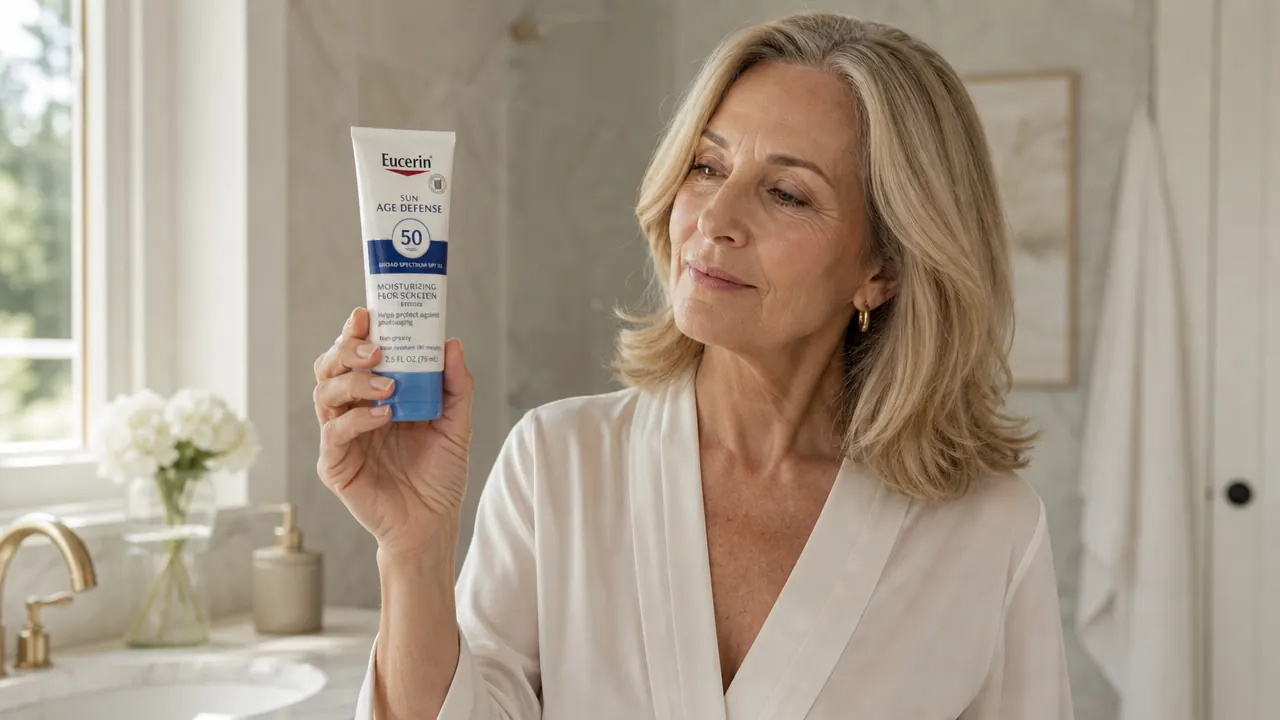
The first thing I noticed when I started using Eucerin Sun Age Defense every morning was how quickly it absorbed and how little it disrupted whatever I put on top of it. My skin is on the drier side, with the kind of fine lines around the mouth and forehead that tend to get crepier in winter. The hyaluronic acid in this formula pulls moisture into the surface layers of skin and holds it there, which makes those fine lines look visibly softer throughout the day without needing me to layer a separate moisturizer underneath first. That matters a lot when you are trying to simplify a morning routine and still get some anti-aging benefit baked into your SPF step.
The finish is notably better for mature skin than most SPF lotions I have tried. Eucerin Sun Age Defense dries to a soft semi-matte surface that my makeup sits on cleanly. I wear a tinted moisturizer over it most days, and I never got that streaky, pilling texture that sometimes happens when a sunscreen has not fully bonded with skin before you layer something on top. The formula absorbs in roughly forty-five to sixty seconds on my skin, which is fast enough to not slow down a morning routine.
At under sixteen dollars for a 2.5 oz bottle, it also delivers real per-use value since a little goes a long way on the face and neck alone. For anyone with thinning, sensitive, or reactive skin who still wants broad-spectrum SPF 50 coverage alongside genuine hydration support, this is the formula I would reach for first. After five months of regular use, I still buy it on refill without hesitation, which for me is the most honest endorsement I can give a skincare product.
Stop letting your SPF step skip the anti-aging work your skin actually needs.
Eucerin Sun Age Defense SPF 50 pairs broad-spectrum UVA/UVB protection with hyaluronic acid in one fragrance-free lotion built for mature, sensitive skin. Check today's price on Amazon.
Amazon Check Today's Price on Amazon →Where CeraVe AM SPF 50 Wins
CeraVe AM SPF 50 has a genuinely strong story around the skin barrier. The three ceramides in its formula are the same lipid types your skin naturally produces, and for women whose barrier function has declined with age, that is not a trivial thing. If you are dealing with red, easily irritated skin that reacts to environmental stressors or gets tight after washing, the ceramide complex in CeraVe AM may actually be the better structural choice over time. Niacinamide is also a real workhorse ingredient, helping with uneven tone and post-inflammatory pigmentation at the right concentration.
CeraVe AM SPF 50 is also widely available in almost every drugstore, which means you will rarely run out without a backup nearby. The 3 oz bottle is a bit larger than Eucerin's 2.5 oz, which helps justify the slightly higher shelf price at some retailers. For women whose primary concern is a compromised or reactive barrier rather than surface hydration and fine-line softening, CeraVe AM makes a reasonable argument. I just found that on my own mature, dry skin, the finish was a touch tackier and the hyaluronic acid payoff from Eucerin was more immediately visible in photographs and in the mirror by the end of each week.
The difference showed up most clearly on days when my skin was at its driest. Eucerin absorbed cleanly and left my fine lines looking rested. CeraVe AM left a faint tackiness that my tinted moisturizer clung to unevenly by midday.
Ingredient Deep Dive: Hyaluronic Acid vs Ceramides for Skin Over 50
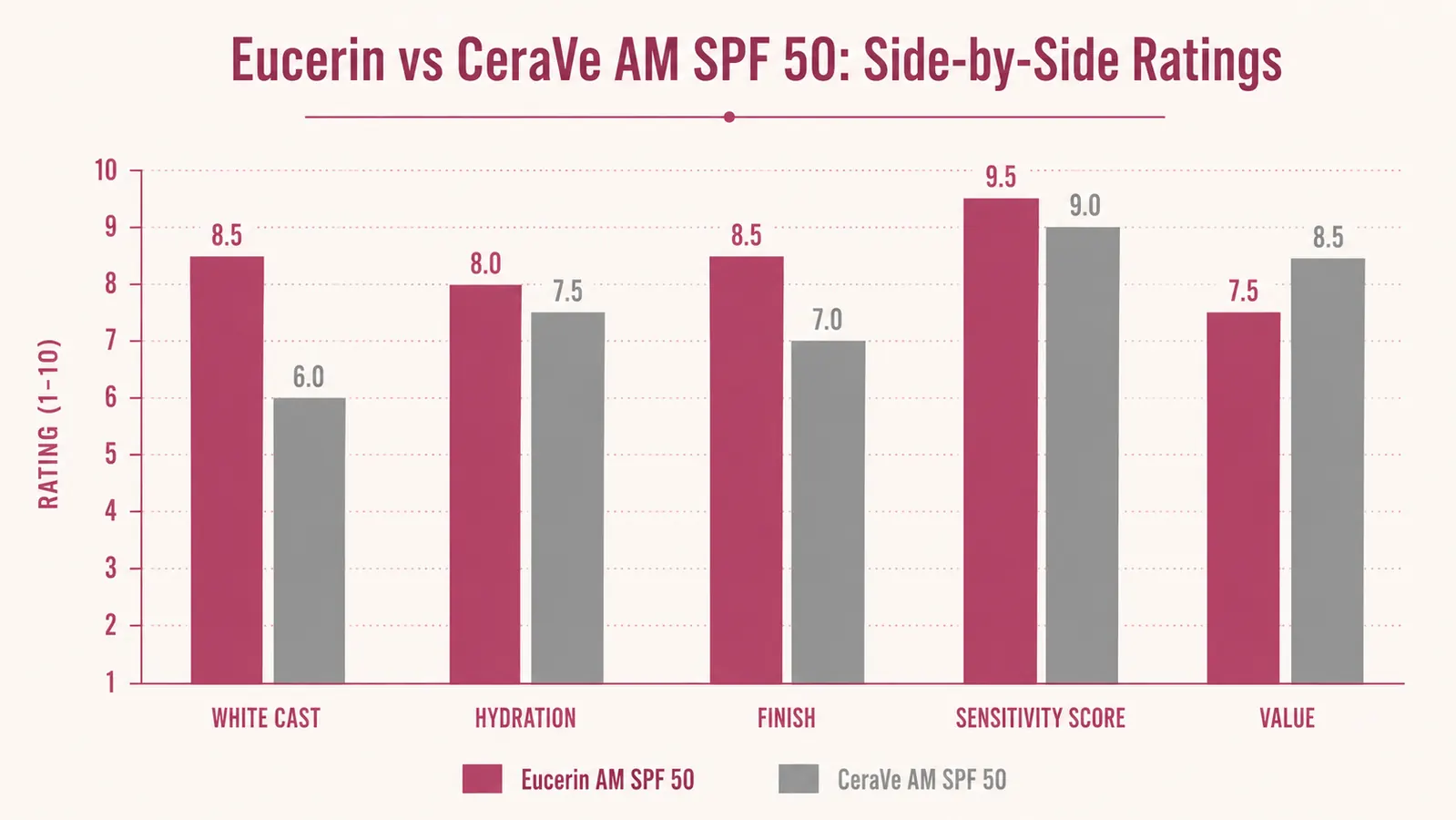
This is the real question underneath the comparison, because both ingredients are legitimately good for aging skin. They just do different things. Hyaluronic acid is a humectant. It draws water into the upper layers of skin and binds it there, which makes skin look plumper and reduces the appearance of surface-level fine lines within hours of application. The results are visible and relatively immediate, which is why serums built around it have become so popular in the last decade among women looking for results they can actually see.
Ceramides work more slowly and deeper. They are lipid molecules that form part of the physical structure of the skin barrier, filling in the gaps between cells and reducing transepidermal water loss over time. A ceramide-rich formula is working to repair and maintain the long-term integrity of your barrier, which affects how reactive, dry, and sensitive your skin is month over month. Both benefits are real. But if I am choosing a daily SPF product that doubles as a moisturizer, I want the one that also gives me visible improvement in how my skin looks and feels that same morning. That gives the clear edge to Eucerin Sun Age Defense for most women over 50.
Texture, Absorption, and Makeup Layering
For women who wear foundation or a tinted moisturizer over their SPF, texture and absorption speed are not minor details. They are the difference between a routine that works and one you quietly abandon after two weeks. Eucerin Sun Age Defense has a thin, fluid lotion consistency that spreads easily across the face with two or three light passes and absorbs in about sixty seconds without leaving any noticeable shine. It does not pill under makeup, and it does not shift your foundation color by adding an overly dewy base.
CeraVe AM SPF 50 is a bit thicker. On well-hydrated days, it works fine and absorbs reasonably quickly. On dry winter mornings when my skin is at its most parched and crepey, I found the CeraVe AM took longer to absorb and left a faint tackiness that made my tinted moisturizer ball up slightly along the drier areas of my cheeks. It was not a dealbreaker for someone who skips makeup entirely, but for those of us who do layer products, the Eucerin formula is the more reliably cooperative partner.

SPF Performance and Photoaging Protection
Both products are rated SPF 50 and both are labeled broad-spectrum, meaning they cover UVA rays (the ones that drive photoaging and pigmentation) as well as UVB rays (the ones that cause sunburn). Both use chemical UV filters rather than physical mineral filters, which is why neither leaves a white cast. The filter combinations are slightly different: Eucerin uses avobenzone, homosalate, and octinoxate, while CeraVe AM uses avobenzone, homosalate, octisalate, and octocrylene. Octocrylene is a common stabilizer that helps prevent avobenzone from breaking down in sunlight, so CeraVe AM's filter system may be marginally more photostable on paper.
In daily use, that photostability difference is unlikely to matter for someone wearing sunscreen indoors and out in ordinary life rather than swimming or sweating heavily. What does matter, long term, is consistency. The product you actually apply every single morning is the one doing the most work for your skin. Eucerin Sun Age Defense is the easier formula to work into a daily habit, which means it will protect your skin more reliably simply because it is more pleasant to use. For a more detailed look at what five months of daily use on mature skin actually produced, I wrote that up in the full review linked at the bottom of this page.
Who Should Buy Which
Choose Eucerin Sun Age Defense SPF 50 if you are a woman over 50 with dry or combination skin who wants her daily SPF step to also soften the look of fine lines, absorb quickly, and wear cleanly under makeup. The hyaluronic acid payoff is real and visible, the formula is fragrance-free and non-comedogenic, and at under sixteen dollars it is genuinely one of the better daily sunscreen values for mature skin. This is the one I reach for on weekdays when I am getting dressed and need my morning routine to move quickly without shortchanging my skin.
Choose CeraVe AM SPF 50 if your primary concern is a reactive or compromised skin barrier, your skin is easily irritated by environmental factors, or you already have a separate hyaluronic acid serum in your routine and do not need that hydration layer duplicated in your SPF. The ceramide complex is a legitimate barrier-repair ingredient and the formula is trustworthy and gentle. It is simply not as well-suited to mature skin that has started to thin and dry, compared to what Eucerin brings to the table in the same price range.
Eucerin Sun Age Defense SPF 50 is the daily SPF built to do more for skin over 50.
Hyaluronic acid, broad-spectrum SPF 50, fragrance-free, and non-comedogenic in one lightweight lotion. Consistent daily use is the single most effective step you can take to slow visible aging from here forward.
Amazon Check Today's Price on Amazon →